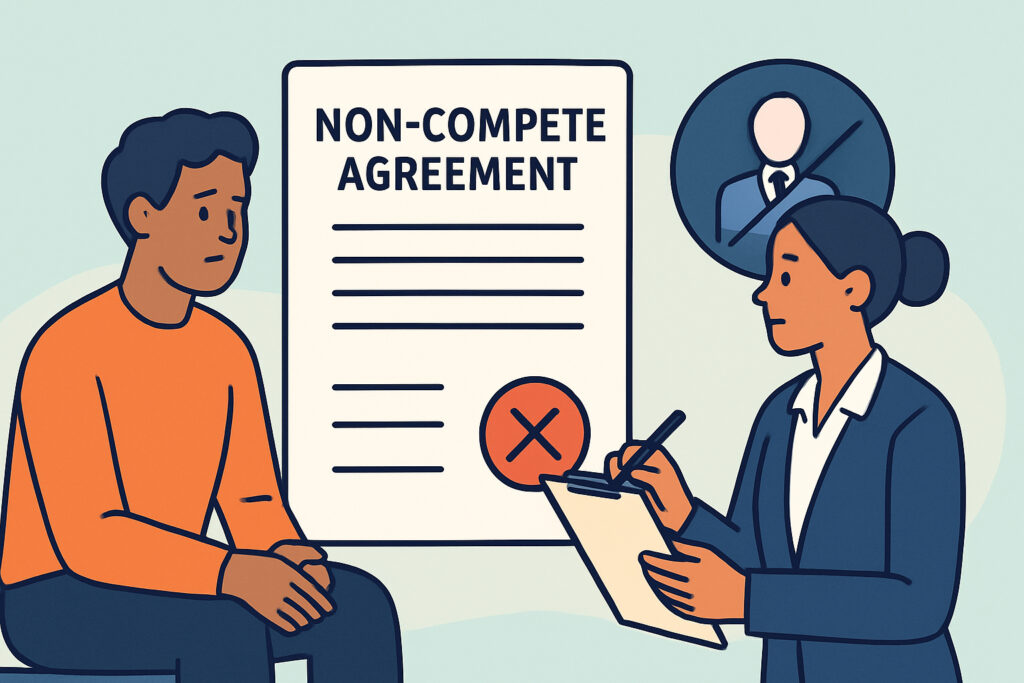
Employee non-compete agreements are among the most frequently misunderstood documents in the American workplace. Whether you’re an employer trying to protect your business or an employee being asked to sign one, understanding the legal requirements – and limits – of these agreements can save you from costly disputes down the road.
What Is a Non-Compete Agreement and Who Needs One?
A non-compete agreement (also called a non-compete clause or covenant not to compete) is a contract that restricts an employee from working for a competitor or starting a competing business for a defined period after leaving a job. Employers commonly use them to protect trade secrets, client relationships, and proprietary business information.
Not every role justifies one, though. Courts consistently look at whether the business actually has a legitimate interest worth protecting – a senior sales executive with access to key accounts is a different story than a cashier or warehouse worker.
The Core Legal Requirements That Determine Validity
Enforceability varies significantly by state, but most jurisdictions require the same foundational elements.
Consideration – There must be something of value exchanged. If you present a non-compete to a new hire before their first day, the job offer itself typically qualifies. Presenting it to an existing employee mid-employment is trickier: in many states, continued employment is not sufficient consideration. A raise, a promotion, or a signing bonus should accompany it.
Reasonable geographic scope – An agreement covering “the entire United States” for a local coffee shop chain is unlikely to hold up. The territory should match where the employer actually competes.
Reasonable duration – Courts in most states accept 6 to 24 months as the standard range. Agreements running three or five years face heavy scrutiny and are often struck down entirely or “blue-penciled” – rewritten by the court to a shorter term.
Protectable business interest – The employer must demonstrate what is being protected: customer lists, trade secrets, proprietary processes, or specialized training the employee received at company expense.
State Law Variations: Where Most People Go Wrong
Federal law does not govern non-competes in the United States. Enforceability is entirely a matter of state law, and the differences are dramatic.
California, North Dakota, and Minnesota have effectively banned non-compete agreements for employees. Signing one in those states does not make it enforceable – the clause is void as a matter of public policy, regardless of what the contract says.
Florida, Texas, and Georgia tend to enforce them more aggressively, provided the agreement is reasonable in scope. Florida courts can actually rewrite an overbroad agreement to make it enforceable, rather than throw it out entirely.
States like New York and Illinois take a middle path: courts evaluate each agreement case-by-case against reasonableness standards, and restrictions on lower-wage workers receive much less deference.
Before relying on a non-compete agreement template, always confirm the governing law clause – and make sure that state actually permits enforcement.
The FTC Rule That Didn’t Happen – and What Comes Next
In 2024, the Federal Trade Commission issued a rule that would have banned most non-competes nationwide. That rule was struck down by federal courts before taking effect. The regulatory landscape remains in flux, and several states have introduced new legislation in 2025 restricting or banning non-competes for employees earning below certain income thresholds.
This matters in practice: a non-compete valid today may not be enforceable a year from now if state law changes. Review existing agreements periodically – especially if your workforce operates across multiple states.
Busting the Most Common Myth: You Can’t Fight a Non-Compete
One of the most persistent misconceptions is that signing a non-compete means you’re locked in permanently. Courts regularly decline to enforce agreements that are overbroad, vague, or disproportionate to the employer’s actual interest.
Factors that often sink enforcement attempts: the employee had no access to sensitive information, the restriction covers roles the employee never performed, or the employer terminated the employee without cause. Some courts also consider whether the employer is actually suffering concrete harm from the departure.
If your employment contract includes a non-compete, reviewing it with an employment attorney before accepting a new position is far cheaper than defending a lawsuit later.
How to Draft a Legally Sound Non-Compete Agreement
For employers, here is what a defensible agreement should include:
1. Clear identification of parties – full legal names of employer and employee, role, and start date.
2. Defined restricted activities – specify the type of competing work, not just “any competitive activity.” Courts prefer precision.
3. Geographic scope – list specific states, metro areas, or regions. Match it to where your business actually operates.
4. Duration – state the exact period in months. Twelve months is the most defensible standard; eighteen months is common in specialized industries.
5. Consideration recital – explicitly state what the employee is receiving in exchange (job offer, bonus, promotion).
6. Governing law clause – designate the state whose law governs the agreement, and choose carefully.
7. Severability clause – if one part is found unenforceable, the rest of the agreement should survive.
Pairing a non-compete with a well-drafted non-disclosure agreement gives employers layered protection: the NDA covers confidential information during and after employment, while the non-compete limits direct competitive activity after departure.
Frequently Asked Questions
Does a non-compete agreement apply if I was laid off?
In most states, yes – the agreement remains in force regardless of how employment ends, unless the contract specifically says otherwise. However, courts in several states including Massachusetts and New York are more skeptical of enforcement when the employer terminated the employee without cause. Always read the termination provisions carefully.
Can an independent contractor be bound by a non-compete?
Yes, but the legal analysis differs. Because independent contractors are not employees, state laws that restrict employee non-competes may not apply. Some states, however, apply similar scrutiny to contractor restrictions. Whether the relationship is genuinely independent – or misclassified – will affect how a court evaluates the agreement.
What happens if I violate a non-compete?
An employer can seek an injunction (a court order stopping you from continuing the competing work) and damages for business losses. Courts can issue injunctions very quickly – sometimes within days of filing. Violations can result in significant financial exposure, so understanding the scope of what you signed before leaving is essential.
Final Guidance Before You Sign or Enforce
Employee non-compete agreements are powerful tools when properly drafted and genuinely necessary – and paper obstacles when rushed through without legal grounding. For employers, the key is specificity and proportionality: the narrower and more targeted the restriction, the more likely a court will respect it. For employees, the key is reading carefully and knowing your state’s rules before accepting a new role.
The most expensive non-compete disputes are the ones that could have been resolved with a careful document review before anything happened.