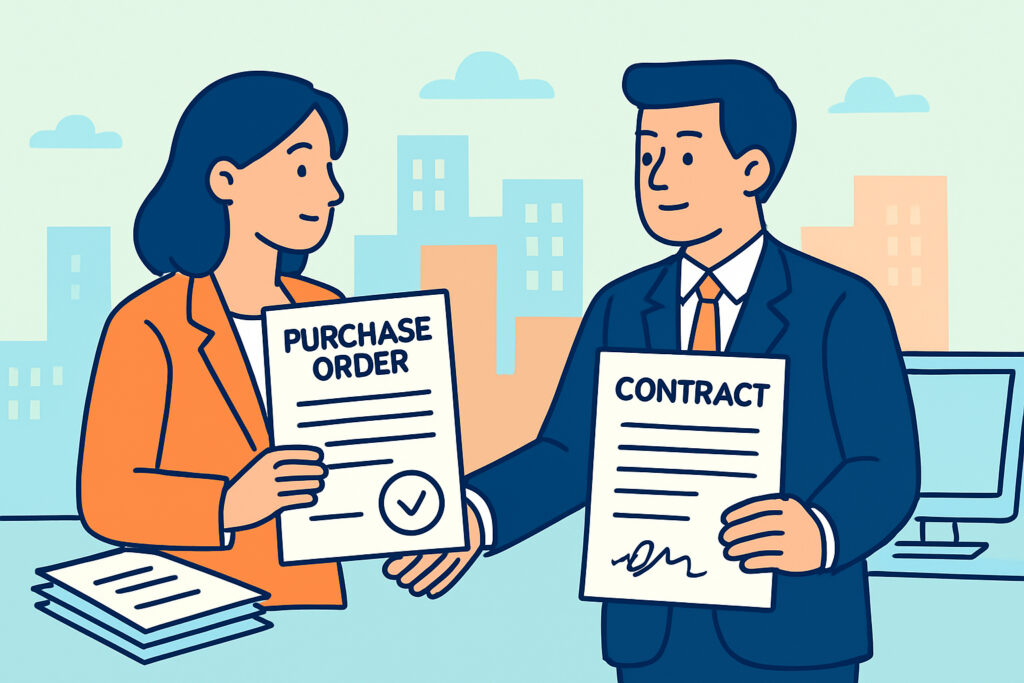
A vendor ships $40,000 worth of custom parts, invoices net-30, and then discovers the purchasing manager who emailed the PO never had signing authority above $10,000 – now the payment is stuck in a dispute that a properly drafted contract would have prevented. Understanding the real legal difference between a purchase order and a contract matters for anyone running procurement, sales, or accounts payable in the US, because the two documents look similar on paper but behave very differently when something goes wrong.
What a purchase order actually is
A purchase order (PO) is a buyer-issued document that specifies what’s being bought, the quantity, agreed price, and delivery date. It becomes a binding contract only once the seller accepts it – usually by shipping the goods, invoicing against it, or sending a written acknowledgment. Under UCC Article 2, which governs the sale of goods in every US state except Louisiana for certain provisions, a PO functions as an “offer” that ripens into a contract on acceptance.
That’s the part people get wrong. A PO sitting in an inbox, unacknowledged, is not yet an enforceable deal. Plenty of small manufacturers have shipped product against a PO assuming they were covered, only to find the buyer disputes quantity or price terms that were never confirmed in writing by both sides.
What a commercial contract adds
A full contract – whether it’s a service agreement or a supply agreement – spells out warranties, indemnification, limitation of liability, dispute resolution (arbitration clause or venue selection), termination rights, and confidentiality. None of that shows up on a standard PO. A PO might reference “Buyer’s standard terms and conditions apply” in eight-point font, but if the seller never actually saw or agreed to those terms, a court in a battle-of-the-forms scenario under UCC § 2-207 will often strike conflicting terms rather than enforce either party’s boilerplate.
This is why repeat commercial relationships – say, a distributor ordering from the same manufacturer every month – typically run under a master supply or distribution agreement, with individual POs issued underneath it just to specify quantity, SKU, and delivery date for each shipment. The supply agreement carries the legal weight; the PO is just the order mechanics.
When a PO alone is legally risky
Three situations come up constantly in practice:
First, high-dollar or long-lead-time orders. If a buyer places a $150,000 custom equipment order via PO with no underlying contract, and the buyer’s business fails before delivery, the seller has no indemnification clause, no limitation-of-liability cap, and no agreed remedy beyond basic UCC damages (cover cost minus contract price, plus incidental damages under UCC § 2-706 and § 2-708).
Second, authority disputes. Many companies restrict who can bind them contractually – a $10,000 threshold for a procurement specialist, board approval above $100,000, that kind of thing. A PO signed by someone outside their authority can be voidable, and sellers rarely check. An experienced contracts manager confirms signing authority before accepting anything past a company’s known threshold, especially with new customers.
Third, recurring services. Consulting, maintenance, or subscription-style work shouldn’t run on POs at all – there’s no “goods” for UCC Article 2 to apply to, and courts fall back to general common-law contract principles, which makes an underlying consulting agreement or services contract essential for defining scope creep, deliverable acceptance, and payment milestones.
Common mistakes companies make
The most frequent mistake: treating a PO number as proof of a deal when no one on the seller’s side confirmed acceptance in writing. A verbal “we’re good, go ahead” from a buyer’s employee isn’t binding if that person lacked authority – get it in an email at minimum.
Second mistake: rolling over an expired master agreement while still issuing POs against it. If the underlying contract lapsed 14 months ago and procurement never noticed, every PO issued since is arguably unsupported by any negotiated terms, meaning the parties default to UCC gap-fillers instead of whatever indemnification or liability caps were in the original deal.
Third mistake: accepting a PO with a payment term buried in it (net-60, net-90) that conflicts with the seller’s standard net-30 invoice terms, without flagging the conflict before shipping. Once goods ship, the seller has effectively accepted the buyer’s terms in many jurisdictions’ interpretation of performance-based acceptance.
How to decide which document you need
A one-time purchase of standard, off-the-shelf goods under a few thousand dollars can often run safely on a well-drafted PO alone, provided both sides exchange written acceptance. Anything recurring, anything involving custom specifications, anything above roughly $25,000–$50,000 (a rough threshold many mid-size companies use internally for requiring legal review), or any service arrangement should sit under a full contract, with POs used only as the ordering mechanism beneath it.
Kysymyksiä ja vastauksia
Voiko ostotilaus (purchase order) olla sitova sopimus ilman erillistä sopimusta?
Kyllä, mutta vain kun myyjä on hyväksynyt sen kirjallisesti – esimerkiksi lähettämällä tilausvahvistuksen tai toimittamalla tavaran. Ilman tätä hyväksyntää PO on vasta tarjous, ei sitova sopimus.
Mitä eroa on PO:lla ja täydellä hankintasopimuksella?
PO määrittää mitä ostetaan, määrän ja hinnan, kun taas hankintasopimus sisältää takuuehdot, vastuunrajoitukset, riidanratkaisumenettelyt ja irtisanomisehdot – asioita, joita PO ei tyypillisesti kata.
Milloin pelkkä PO ei riitä?
Kun kyse on toistuvista tilauksista, korkean arvon hankinnoista, mukautetuista tuotteista tai palvelusopimuksista – tällöin tarvitaan täysi sopimus, ja PO toimii vain tilausmekanismina sen alla.
Tärkein käytännön muistisääntö: PO kertoo mitä ostetaan, sopimus kertoo mitä tapahtuu, jos jokin menee pieleen. Kun rahasumma kasvaa tai suhde jatkuu kuukausia, kannattaa aina varmistaa, että molemmat dokumentit ovat kunnossa – ei vain toinen niistä.